A Surly's Last Dance: Six Days in Scotland


In Scotland, on some early-May afternoon, I was one of four cyclists in the middle of a hike-a-bike stretch. There is no photograph of the following moment, and that is the great tragedy of this story.
Picture it anyway. All 194 cm (6'4") of me, sunk to the knees in Highland peat, holding a loaded Surly Midnight Special above my head with both arms extended like Rafiki presenting Simba to the savannah, except the savannah is a soaking plateau on the Ardnamurchan peninsula and the lion cub is a 2×11 steel frame with 50-mil tyres. Behind my out-of-focus body, in the photo I keep picturing in my mind, the profile of Skye traces the only line dividing two impossible blues: the Atlantic on one side, a Scottish sky on the other, finally remembering how to be clear. Matteo had stopped just before, so I went first. The matted bog crust of mud and water, which had felt like riding on something floating in a "we'll ride this, it's fine" mood, collapsed mid-stride, and the bog took me politely up to the femur.
There was no photograph because everyone was busy laughing at me.
A Year Late, Two Days Short
This kind of trip was meant to happen last year. Last May, instead, I was dealing with life and the trip got folded up and put away. I wrote about that in Two Wheels and the Weight of Loss, but I won't unpack it here except to say that this May, exactly one year on, the trip needed to happen. Even when, a few weeks out, an exam date came down the chute at work and ate two days off the back of our calendar. Even when the new bike I'd been waiting for was due to be collected from Fairlight's London HQ on a date I was no longer going to be in London. Eight days shrank to six. The pickup became a Glasgow bike shop that didn't yet know it was about to babysit a frame for me. We made it work because if we hadn't made it work, we wouldn't have gone, and we wanted (needed) to go.
The frame in question: a Fairlight Secan 3.0 in Root Beer and yes, that colour name led me to the choice as much as the geometry did. I am, for the record, an avid beer lover who once travelled to Liverpool partly to drink a pint and eat pies. (We'll come back to the pies.) The Secan was waiting for me, somewhere, in some Glasgow stockroom. But for the next six days, the bike I chose was still my Surly Midnight Special. This frame was, by every objective measure, slightly wrong for me. Too small. Toe-clearance issues. A wobbling micro-shimmy when fully loaded that I had never quite chased out of it. I bought it with the first proper paycheck of my intensive care residency, and I have loved it stupidly for years since.
This was going to be its last dance. We both knew it.
Hitting Nature's Paywall
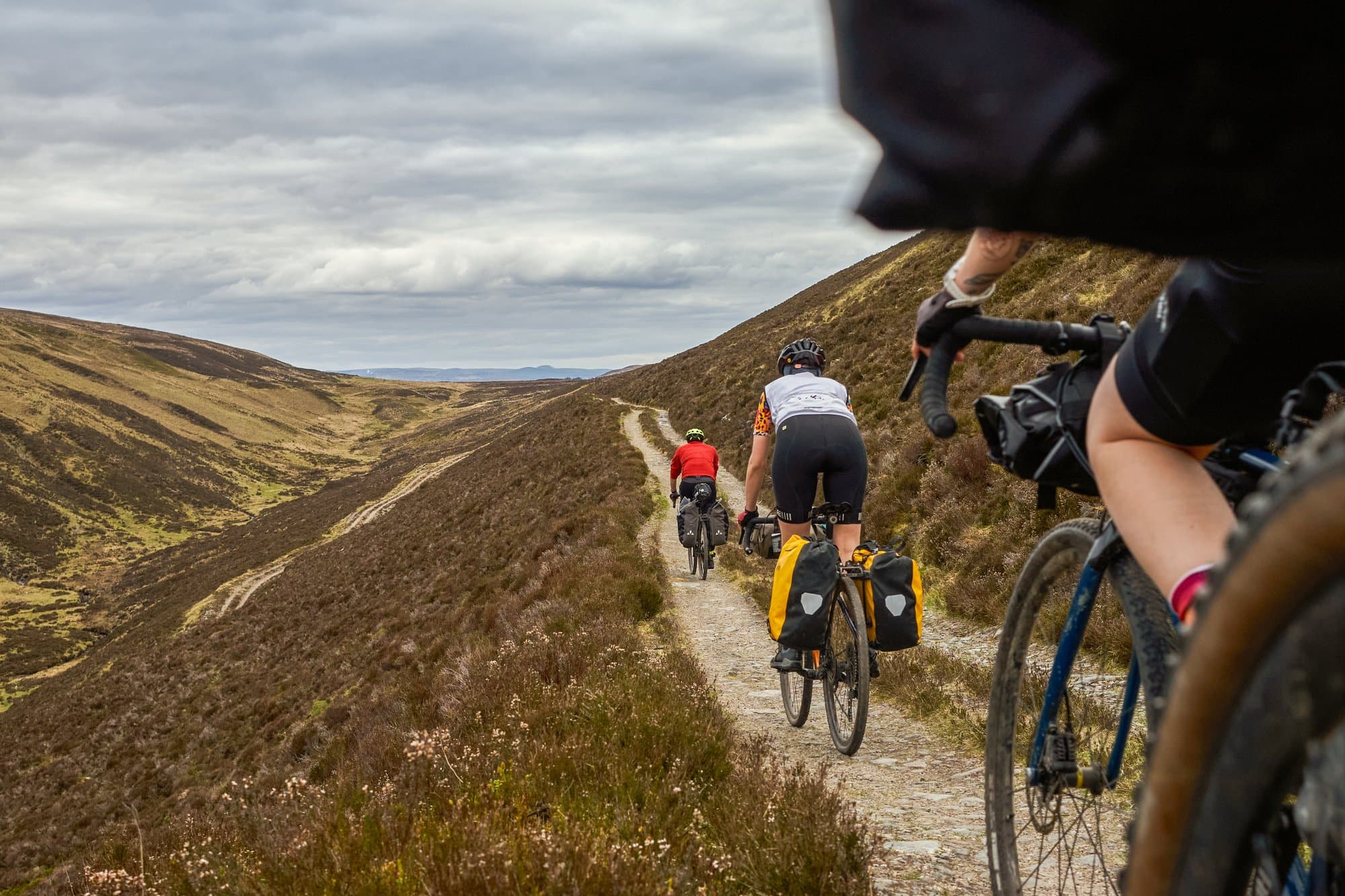
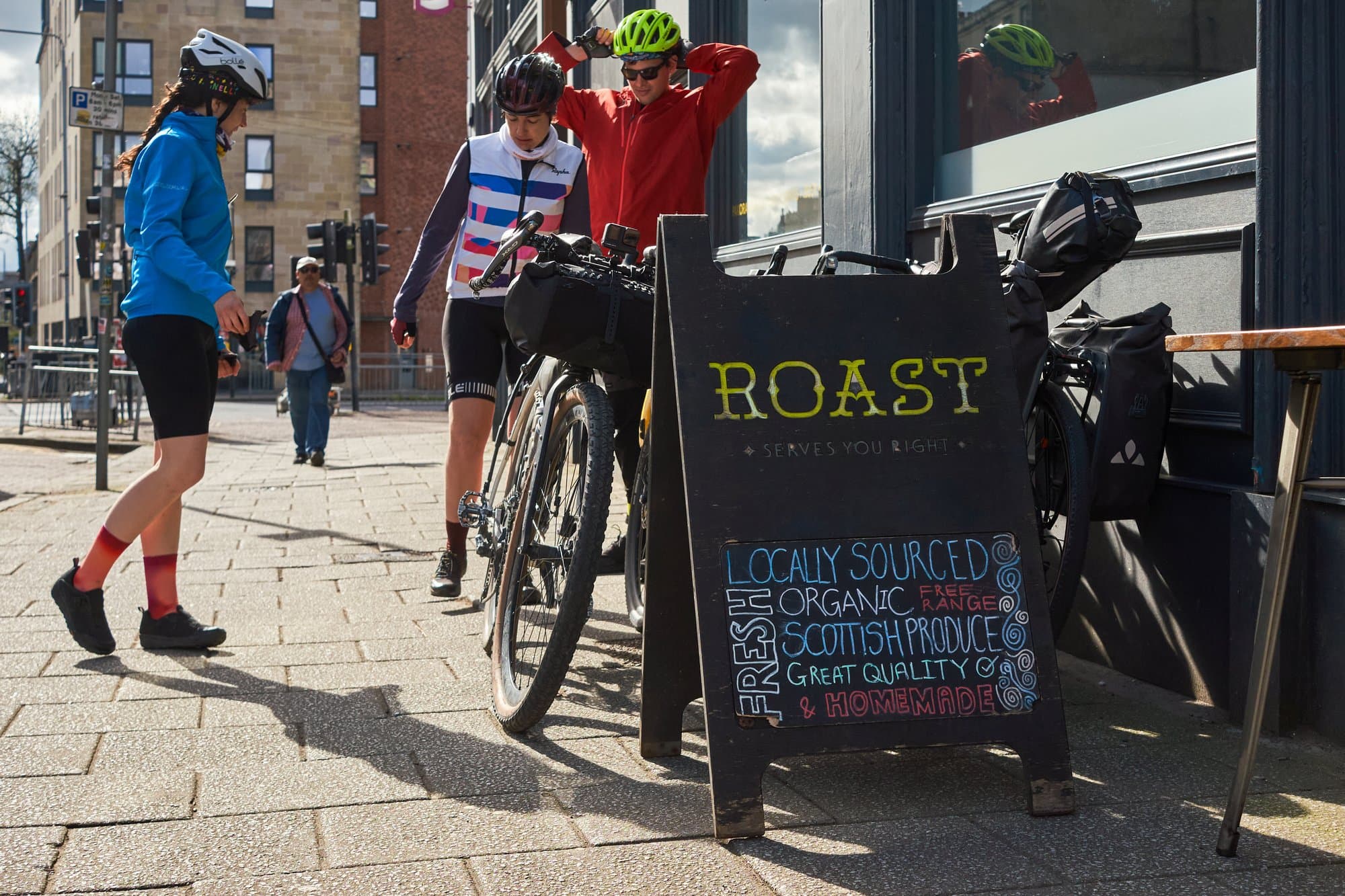
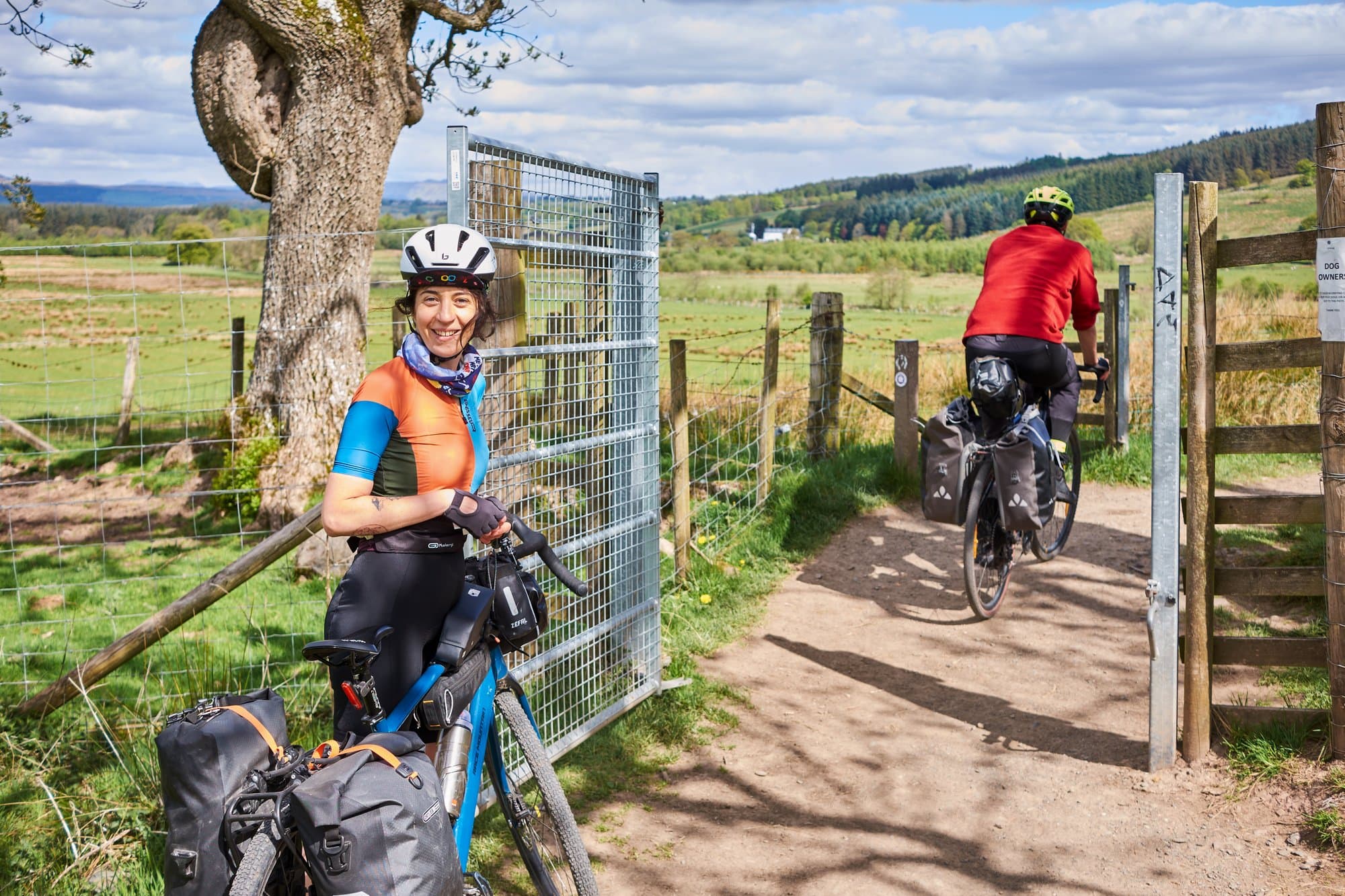
We left Glasgow after the most respectable Scottish breakfast we could find at Roast: porridge, bacon, scrambled eggs, black pudding, hot coffee, think one, eat one and joined the Badger Divide heading north. The first hour was strange. Where were all these people coming from? We were three months into the planning of an introvert's escape and we had somehow chosen a route that doubled, for its opening section, with the West Highland Way and a major gravel through-route. Bikepackers, ultralight runners, retirees with poles, somebody's dog. Then a sharp left turn, almost an afterthought on the GPX file, pulled us off the main artery and into the quiet. The crowd evaporated. Four of us, then. Me and Valerie. Valentina and Matteo. Four bikes on a fence-and-gate gravel road, learning the choreography of opening and closing every twenty minutes, learning the dance.
Climbing into a forest of beech trees, we watched the late-morning light come through in shafts. Moss everywhere: on the trunks, on the stones, on the ground between the path and the path's idea of itself. This was not an Italian forest. This one was wetter and older and stranger, and somewhere on the way up the first proper climb I remember thinking that this was the right country in which to be doing this. That feeling did not last all six days. But it kept coming back.

The nature's paywall arrived two days in. Scotland gates you with weather; this was the toll.
Imagine leaving a small village at half past seven in the morning. A village that exists almost entirely as a tourist staging point. We'd taken its warm shower and its roof, leaving it not unkindly so much as quickly. Nothing was open for breakfast. We bought packets of biscuits at the local mini-market and, on a paranoid whim of mine, a small grey tube of mystery cream that promised to heal burns, scrapes, wounds, infections and probably grief. (Foreshadowing.) We ate the biscuits against a Scottish morning breeze that does not so much blow as slap. We pushed on.
The promised tearoom at Rannoch station was, of course, closed for its weekly day off. The promised muffins and scones existed in some adjacent dimension. Then it began to rain.
What saved us was a sentence I had not previously imagined writing: "Scotland's remote railway stations are the warmest place a wet cyclist will find." At Rannoch we slipped into the waiting room and discovered, in one of those quietly Scottish acts of trust, a corner stocked with instant porridge, biscuits, a kettle, packs of Nescafé, and a money box. You picked what you wanted; you left what it cost. We sat for an hour and ate hot porridge and got the feeling in our hands back, and then we put the wet clothes on again and went out into the same wind and the same intermittent rain, this time toward Corrour.
Corrour is one of the most remote railway stations in the United Kingdom. The nearest road is sixteen kilometres away. If the name rings a bell, it is the platform where Tommy in Trainspotting drags the boys off the train and asks if it doesn't make them proud to be Scottish, before Renton delivers the monologue you can probably recite. We were not feeling proud. We were feeling cold and slightly hallucinatory. Corrour, too, had a tearoom. Corrour, too, was outside opening hours.


The Bothy Was Not Empty
We met one person on the entire section. A man walking the length of the country, east to west, alone, on day fifty-six. He was the kind of person you only meet in places where most people aren't: weathered, polite, slightly elsewhere. We exchanged about thirty words and went on. Storming wind, broken-down gravel, improvised stream crossings where the rain had rewritten the route in real time, fog. Scotland was charging the entry fee. We paid it. By the end of the day my legs were quiet and my head was very clear, and I think that is something this country does to you on purpose.
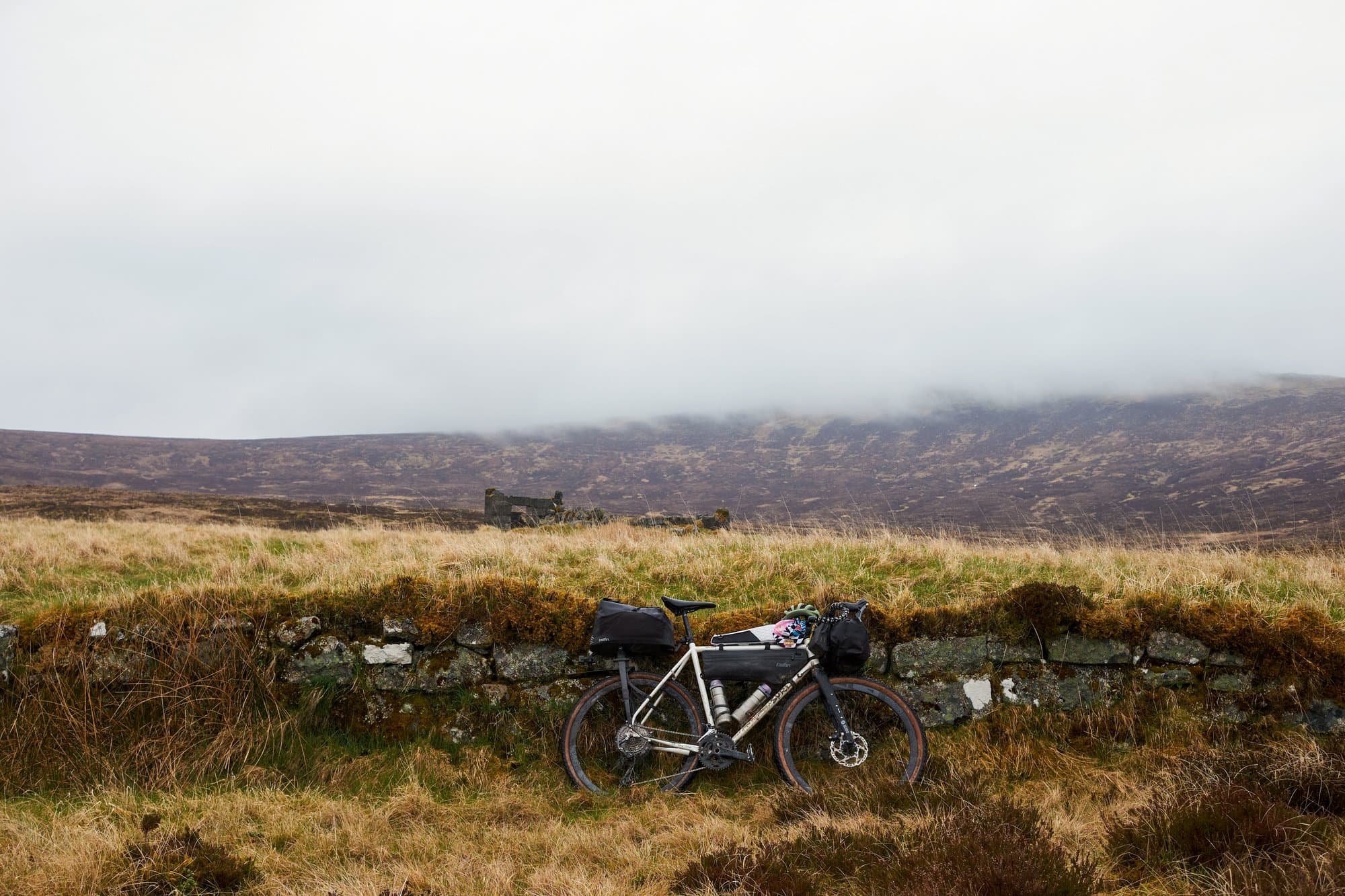
A bothy, for the uninitiated, is something between a barn and a generous stranger's house: a shelter that nobody officially maintains in remote Scotland, kept up by volunteers and used by anyone who needs a roof. The deal is unwritten and obvious. You bring what you need (stove, candles, sleeping mat, food, common sense). You take everything out. You shut the doors. You don't shit indoors. We needed the bothy more than I had admitted to anyone. Wild camping the early-May Highlands with damp gear is its own variety of bad. I'd arrived first, alone, slightly ahead of the others, having spotted the cairn and a thin tin-foil house-shaped sign marking the turn-off. Ten minutes of pushing the bike through a path I would not have ridden if you'd paid me, the late sun coming sideways through more moss, and there it was. Stone walls, slightly bulging, definitely still standing.
It was not empty.
The other tenants made themselves known around the time we got the stove going. Three bats came out of wherever bats sleep when they're alone with their thoughts and began a chaotic figure-eight around the small room, more frightened of us than we were of them, which is saying something. We won the first negotiation diplomatically: open door, low voices, slow movements. The bats left. A second sortie required more strategy and the eventual heroics of Matteo, who effected a bat-in-a-pillowcase capture-and-release of which we still speak in respectful tones. No bat was harmed. We were the intruders.
Valentina, somewhere in the choreography between cooking and not standing on a sleeping mat, stumbled into the very hot wood-burning stove and stopped her fall with the palm of her right hand.
This is where the trip nearly became something else. I am, for my day job, an intensive care doctor. I am also, relevantly here, a man who packs first-aid kits for an eight-day trip and does not unpack the medical paranoia when the trip becomes six. We had what we needed. We had, additionally, the small grey tube of universal-cream-of-the-Highlands from the suspicious mini-market, which I deployed with no expectations and which, against all clinical sense, behaved. The burn was real. Valentina was fine. She rode the next day, and the day after that, and the day after that, with a bandaged hand and not one word of complaint.
We then learned Briscola by candlelight, which is the correct order of operations. A modified Briscola, because by then we were no longer just four cyclists: a fifth had already shown up.
Livio joined from the third day. He is a friend of ours, a postdoc in Glasgow, and emphatically not a cyclist of the kind that the rest of us are, so he joined with an e-bike. I thought: e-bike, he will be fine. I will admit that the moment I saw the e-bike he had rented for the back half of the trip, my paranoia, which had been so productive at the mini-market, turned itself on full. It was a town bike at best. It was certainly not the e-MTB I expected: a Raleigh city-touring bike with front suspension, slick Schwalbe Marathons inflated to about the same pressure as my road bike at home, and two spare batteries. We tried to figure out the routing on the fly, day by day: detours on the rougher days where the railway line was always within bail-out distance, three of us muscling the bike up sections where it had no business existing, a long workaround out of the bothy day that brought him into our evening reunion with one dead battery and the spare one at a resilient 2%. He kept turning up. We kept laughing about it. The granny-shaped Raleigh did not finish the trip without scars, but it finished the trip, and Livio added a particular spice to the group that you can only get from including the one person who, on paper, shouldn't have been able to come.

Gifts and Warnings
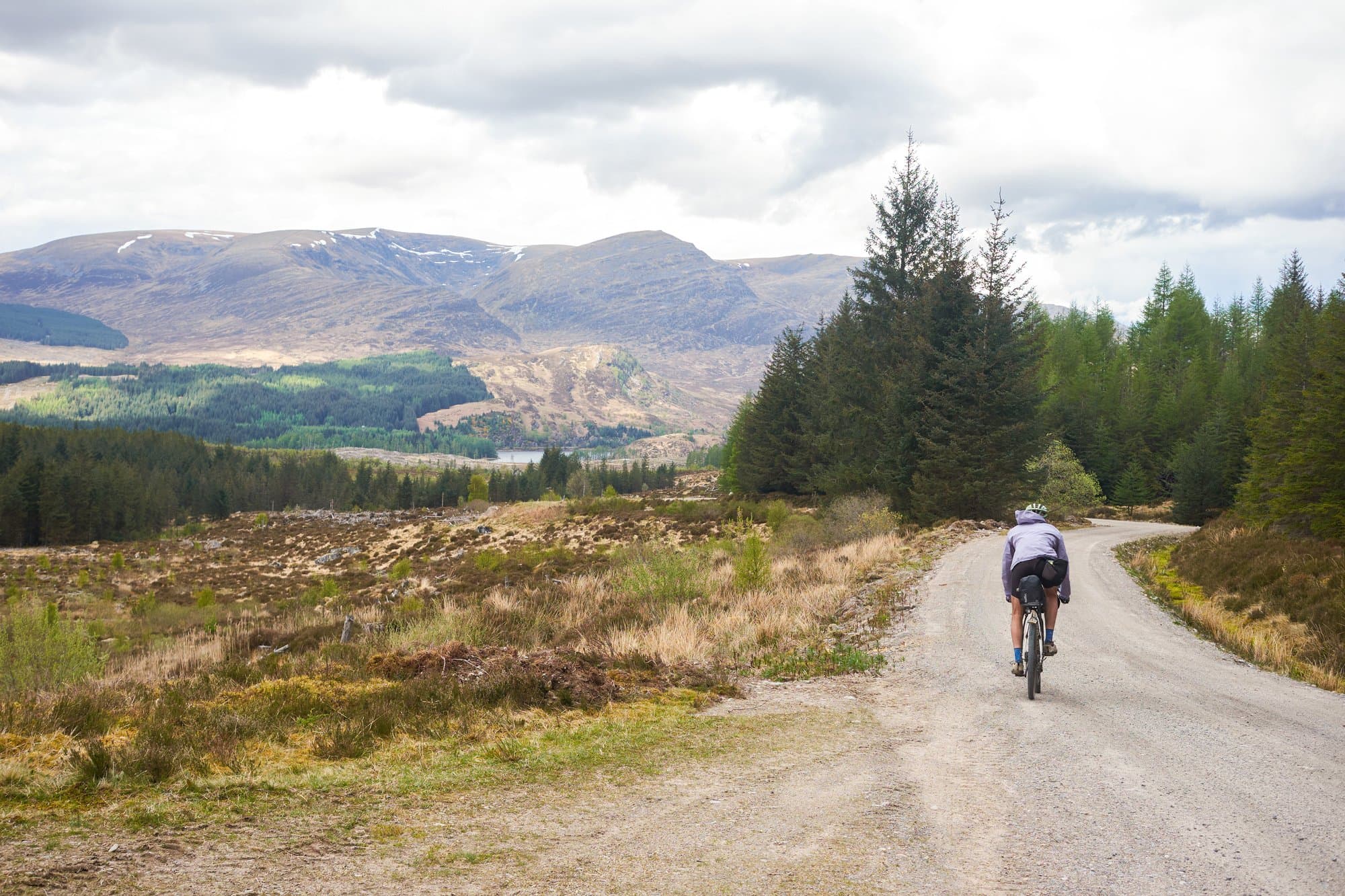
We came down a winding paved descent off the Highlands crossing: barren, bleak, the only living things visible at distance were a few sheep that did not seem to know what we were. Then, all of a sudden, the road slid us into a small green valley filled with lambs. New lambs, days old, unstable on their young legs, the kind whose ears were still too big for their faces. They scattered politely as we coasted between the grazing pastures, then ran in the diagonal lines of small mammals who don't entirely trust their feet, toward the safety of their mothers. The sun was halfway through deciding whether to keep working that afternoon. Nobody in our group spoke for about ten minutes. I would like to be on record as saying that this was one of the most perfect ten minutes of the trip so far. Those moments had arrived as a gift.
A gift on top of some Band-Aids though. Earlier that morning, those same barren bleak hills had claimed our first fall on a slippery technical descent. No consequences beyond a scratched knee and a pair of leg warmers that did not survive. At the bottom of that descent, on the verge, lay the corpse of what had once been a sheep. We do not know what put it there. Either way: Scotland had warned us. This is not an easy country to live in.
Nor to eat in.
Pie is a traditional Scottish and English food I have loved since 2016, when a detour near Anfield, in Liverpool, put me in front of the best pie I had eaten in my life. So when the menu in a pub on Mull offered pies in both meat and vegetarian options, we ordered with the confidence of people about to make an excellent decision. The Pie Drama began.
We were halfway into our pints of Guinness when the pies arrived, and our two vegetarians (Valentina and Valerie) discovered that in Scotland the word pie covers, among other things, a single-crust open-faced pastry construction. The double-crust, sealed handheld English pie of my Liverpool memory was not a universal definition. What arrived for the carnivores was... fine. What arrived for the vegetarians was a tart with ambitions. We laughed. We drank. We ordered more chips.


The Fairlight Was Waiting
Scotland is a country of small islands, and our last two days were island days: short ferry rides on the kind of small, rusting, slightly oily-smelling boats that feel old in the way that good knives feel old. We watched our loaded bikes get strapped to the roof with ropes that had clearly tied other things, and felt the very specific pleasure of crossing water while not pedalling. Mull is its own country inside a country. The light is different. The rain is different. The paved single-track roads are full of slow-moving cars and camper vans with little space for bikes. We respected each other.


We finished in Oban on a Sunday and rolled back into Glasgow the following morning. In the waiting days in Glasgow I walked into Billy Bisland Cycles, a shop that had agreed with the easy generosity of a properly good bike shop, to receive a frame that Fairlight had originally planned to hand me in London. The Root Beer Secan was in a box waiting for me. I am building it up now. I think it is going to be a very good bike.
The Surly is in the garage. I will probably sell it, eventually. I should sell it. It is the wrong size. It wobbles when loaded. I have a better bike for the kind of trips I want to keep doing. But I keep finding reasons to leave that decision until tomorrow. Maybe next week. The first proper bike you buy with the first money you earn doing the work you wanted to do is not really a bike. The Midnight Special carried me through a residency, through a year I do not want to write more about than I already have, through six days of Scotland that arrived a year late and two days short and were, somehow, exactly enough.
I think we did this trip with the minimum possible number of setbacks; everything went buttery smooth in the end. The mini-market grey-cream kept its promises. The bothy bats added a chapter. Livio's Raleigh was a sustained, absurd negotiation with physics. The femur-deep mud took my dignity away.

By the Numbers
Glasgow, Callander, Bridge of Gaur, Fort William, Strontian, Tobermory, Oban. Six days, 484.52 km, 6,580 m of climbing. Five riders, four bikes, and one nonsense Raleigh. One Surly farewell, two ferries, two bothy-bat battles (all extracted alive), and one pie misunderstanding we are still chewing over.