Exposure Lights: Built for Night After Night


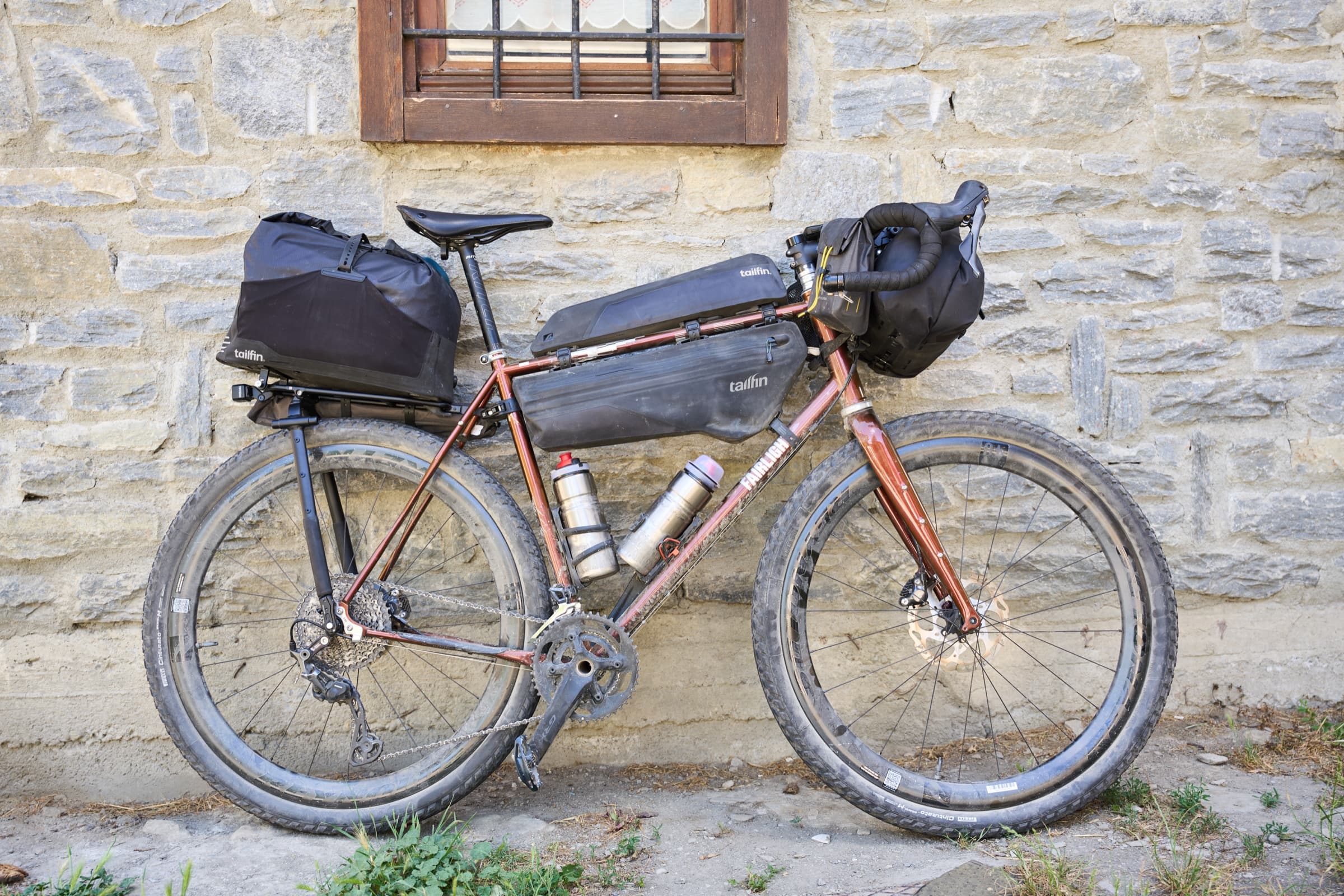
For the first 300 kilometers of the Traka Adventure, I had never felt stronger on a bike. My legs felt immune to the 6000 meters of climbing from the Girona start line to the long downhill that pointed back toward the Costa Brava. In the small town of Albanyà, I managed to slip into a pub just before last call and order a hot meal.
While I waited, I set up my lone headlight. It was nothing compared to the lights I saw on the riders who arrived after me. I rarely ride in the dark, so I had never bothered to update my old 1000 lumen setup.
Darkness, Flats, and the DNF
In the hours that followed, I paid for that oversight. My light technically had a 2500 lumen boost mode, but I was afraid to use it. My plan was to ride the full 560 kilometer course in one push and I needed my battery to last roughly ten hours until sunrise. I kept adjusting the output, dropping from 1000 to 750 lumens depending on the terrain. Then disaster struck. On a fast and rocky straightaway, I hit a rock hard and heard the sharp hiss of air and sealant. Plug, air, ride, flat. Repeat. Over the next few kilometers, I used every plug and both spare tubes. The tire just wouldn't hold air.
An entire year of dedicated training unraveled because of poor equipment choices. I scratched from the race and began walking toward a distant train station.
A Guiding Light
When I returned to Canada, I contacted Exposure Lights. I had seen their lights on countless bikes at Traka, including the setup used by fourth place finisher Chris Mehlman, and wanted to try them for myself. I obtained the Toro 15, Diablo 14, and the BoostR ReAKT + Peloton rear light for testing.
While writing this review, I also reached out to Chris because he has far more experience riding through the night with Exposure's lights than I do. He has raced multiple ultras with the Diablo 15 and BOOST-R, and his insight helped me understand how I'll likely use these lights in future race attempts.


With the new lights charged, I mapped a 560 kilometer route across Vancouver Island. My plan was to recreate the Traka Adventure. I made it less than halfway. Extreme heat pushed me deep into dehydration, and I needed a ride home. Before I could attempt a second ride, I crashed my mountain bike and broke my left hand.
In mid September, stuck in a cast, I emailed Exposure Lights with my growing list of excuses. Dehydration, injuries, and bad timing all contributed to a very delayed review. Not only did Exposure understand completely, but they also sent updated models. The Toro 15 and Diablo 14 had been replaced by the Toro 16 and Diablo 15.
I originally wanted to recreate the Traka Adventure but this was no longer possible. Instead, I have used them on multiple shorter gravel rides and mountain bike laps as daylight disappeared through fall and winter. This became the perfect way to build confidence in a new setup. A year too late, maybe, but the lesson finally stuck.
About Exposure Lights
Exposure Lights is a UK brand, born directly from 24-hour cross-country mountain bike racing. After completing a full 24-hour event, the original founders were so disappointed by the lights available on the market that they decided to build their own. Since that moment, they have continued to refine and improve every new generation.
Their lineup now covers mountain biking, gravel, road, and commuting. They also produce dynamo and e-bike specific models. Outside of cycling, they offer a larger catalogue for hiking, motorcycles, and marine applications.
The features are thoughtful. Reflex mode adjusts brightness based on speed and effort. The OLED display shows the remaining runtime. The ReAKT and Peloton functions on the rear lights react to braking and group riding. Everything is designed to handle rough weather and long nights.
Exposure Lights also have a strong presence in bikepacking and ultra racing. Their supported riders regularly finish near the front. Recent results include Alex McCormack winning the Atlas Mountain Race and setting a double Everesting World Record, Chris Mehlman finishing third at Badlands, and Danni Shrosbree winning Badlands in 2024.
Design and Construction
The Toro 16, Diablo 15, and BOOST-R ReAKT + Peloton Mk2 all share the same core Exposure Lights design. They use an aluminum body that feels durable and ready for rough conditions. All three lights use internal batteries, which eliminates the need for cables or external packs. The lights are quick to swap between bikes and simple to travel with.
Mounts are straightforward, too. The Toro 16 can be moved between bikes quickly using either the dedicated Exposure handlebar mount or a GoPro-style adapter.
The Diablo 15 includes two mounts: a bar mount that is easy to use with a simple rubber band and a helmet mount designed to thread through almost any vent. While the helmet mount is clever, the round bracket is too small. On helmets with large vents, like my Smith Trace, it sits awkwardly. A slightly wider or rectangular bracket would likely fit more securely across a broader range of helmets.
The BOOST-R uses the simplest mounting system of all: a single elastic strap holds a plastic mount cleanly around the seatpost. Despite how minimal it looks, it has never slipped or moved. Because USB-C charging is now standard across all three models, recharging and packing are simplified. One cable handles everything. This change alone feels like a major upgrade from the previous generation.
Why I Chose These Models
Exposure's lineup is large, but choosing three lights was easy. I needed a setup that would work for ultra-distance gravel, bikepacking, and some cross-country mountain biking. On their website, Exposure Lights uses a hexagon-shaped discipline chart to show each light's intended use. The options include DH/Enduro, Trail, XC, Gravel, Road, and Urban.


The Toro 16 is considered ideal for Gravel and XC, with enough power and beam width to handle light Trail use. The Diablo 15 is rated highest for XC and Trail, while leaning more toward DH/Enduro than Gravel, which makes sense for a helmet-mounted light that is needed to push hard on descents. The BOOST-R ReAKT + Peloton Mk2 offered reliable rear light with a clear signal and a long enough battery life to handle any ride.
Together, the three lights form a complete system. This combination matched the lessons I learned at the Traka Adventure and felt like the most balanced way to approach future ultra-distance efforts.
Toro 16
The Toro 16 ($385 USD) is Exposure's main high-output gravel and XC light. The details say it delivers a maximum of 3850 lumens with a 12 degree spot beam. It weighs 260 grams and has a maximum runtime of 36 hours.
One of the standout features is Reflex 2.0. This system automatically boosts brightness when the bike is moving fast and dims it during slower sections like climbs. The goal is simple. Use extra power when it helps and save battery when it does not. In its brightest Reflex setting, the Toro 16 can put out up to 3850 lumens for about three hours. I typically use the 1200 lumen Reflex option, which delivers up to 1200 lumens for 12 hours or more. This is the ride-all-night mode I needed to safely navigate the Traka.
I have used the Toro 16 for commuting between Cumberland and Courtenay, BC in low light and full darkness. On its own, it produces enough light to ride comfortably on rural roads. On gravel rides and XC laps, it pairs well with the Diablo 15 on my helmet. The Toro handles the main workload, and the Diablo lets me look around a bit more and anticipate what's around the next corner.
I have run the Toro 16 with two different mounts. On my gravel bike, I use a GoPro-style mount under my head unit. This centers the light above the front tire and creates a clean cockpit. Because the light sits upside down and slightly recessed, the power button is harder to reach, but the setup is worth it. On my mountain bike, I use the supplied 35 mm handlebar mount. It includes a rubber shim for smaller bar sizes and holds the light securely on rough terrain. It does make for a crowded cockpit when run alongside my Garmin headunit, but it works.
Exposure uses a proprietary quick-release cleat system to attach the light to the mounts. It is simple and secure, although the small screw that secures the cleat to the light has rattled loose on me a couple of times. When this happens, the light sits slightly crooked and is harder to remove from its mount. A small amount of Loctite seems to have permanently solved the issue.
The OLED display is a feature I want on more lights. It shows the remaining runtime in real time, which lets me decide whether to save battery for an all-night ride or use more power when sunrise isn't far away. Although changing modes is not very intuitive, there is a cheat sheet printed on the body of the light that shows the expected lumens and runtime for each setting. The light can also be used to charge other USB-C devices, but be careful. I cannot imagine anything more frustrating than being left in the dark after topping up a Garmin.

Diablo 15
The Diablo 15 ($260 USD) is Exposure's updated helmet-focused light for mountain biking. It is brighter and lighter than the previous Diablo 14, producing up to 2000 lumens. When mounted on my helmet it lets me scan further ahead, look through corners, and fill in the shadows left by a bar-mounted light.
After Traka, I asked Chris why a helmet light like the Diablo is essential in his races.
“While a light like the Exposure Six Pack or Toro 16 has plenty of power and battery life to work alone,” he said, “having a helmet light like the Diablo allows me to look ahead further around corners, and, in case I need to fix an issue on my bike, avoid the hassle of digging out a headlamp. I'm able to ride faster and with more confidence knowing I'm ready for whatever terrain or complex maze-like routes a race throws at me.”
Much like the improvements to the Toro 16, the key upgrades on the Diablo 15 are the USB-C charging and the refined internal electronics. Instead of the OLED display showing precise remaining runtime, the Diablo uses a set of LEDs on the body as a fuel gauge and mode indicator. The tap function lets me change modes by tapping the light, even with gloves on.
Although the light works well once I learned the various settings, it's still a challenge to change modes on the fly. All the indicators are tucked away on the back of the light, on the top of my helmet My solution was to just stick to the mid-level settings, which provide several hours of usable brightness rather than try to flip between modes or brightnesses.
Chris shared a similar runtime strategy, although it was far more structured than mine.
“I ran mine in mode 6,” he said, “which gives 10 hours on high, 24 on medium, and SOS flash in case of emergency. I tend to be conservative with battery usage, but because I run both the Six Pack on my bars and the Diablo on my helmet, I can get away with that. I never had to charge my lights during the 41.5 hours of Badlands.”
He pointed out that even the relatively low lumen output of the Diablo in this mode, around 230 lumens on high, still makes a meaningful difference when descending in the dark.
It ships with a helmet mount that fits between most vents. The quick-release system holds the light securely, even though I had my doubts the first time I used it. Even though the Diablo is designed as a helmet light, it can be mounted on the handlebars in a pinch. On its own, it is bright enough for commuting or simple night riding.


BOOST-R 3 ReAKT
While the name is a mouthful, the BOOST-R 3 ReAKT ($110 USD) is Exposure's most popular rear light. It is a compact, highly visible option designed for commuting, gravel riding, and ultra-distance events. Again, the details shows an impressive 200 lumens and runtime up to 70 hours depending on the mode.
When I asked Chris how he uses the BOOST-R in ultras, he admitted he often shuts it off when riding in isolated areas.
“I often turn it off in remote areas because, out of sight, out of mind,” he says, “but anywhere there are cars, it adds a lot of peace of mind.”
In full transparency, I still prefer riding with my Garmin Varia radar because it warns me when cars are approaching. But it requires daily charging. Even though the Varia is rated for longer battery life, I rarely see more than four to eight hours in real use. With the BOOST-R 3 ReAKT, I never think about the battery at all. It almost always has enough life for one more ride.
I really appreciate the light's DayBright mode. It might save my life, especially on busy roads. The pulse pattern is designed to cut through daylight and traffic. While I wish cyclists didn't have to keep themselves safe on the road, that is the reality many of us experience. I value a light that helps keep me visible and out from under the bumper of a fast-moving truck.
For my own riding, there are a few modes that go unused but they could be considered important to some users. PELETON Mode automatically dims the beam when it detects a rider behind you. ReAKT mode flares under braking and adjusts brightness based on ambient light.
Even though the seatpost mount looks unusual with its horizontal mount, it has been completely reliable. Charging is USB-C, which keeps things consistent across all three lights. The only drawback is the rubber cap covering the charging port. It works, but it is awkward to access and usually needs to be pried open.
Where These Lights Take Me Next
Switching to Exposure Lights has been a huge improvement over my previous setup. In hindsight, they likely would have made the difference between scratching early and finishing the Traka Adventure. Because I had not upgraded my lights in more than five years, the improvements I discovered are staggering. It is an easy win for Exposure to stand out over what I used before, but after speaking with Chris and other Traka participants, I genuinely believe they are among the best options on the market.
There is no way around the fact that they are expensive, but I find the price reflects the very high quality. The Toro 16 costs $385 USD, the Diablo 15 comes in at $260 USD, and the BOOST-R 3 ReAKT is $110 USD.
The jump in brightness, battery life, and charging speed makes my old lights feel outdated by comparison. Exposure's quality and clear buying guide also made it easy to choose a system that matches the way I ride.
Night riding is still not my favourite, but these lights make it easier, safer, and far less stressful. They remove most of the uncertainty that used to come with riding after dark. At some point, I will take another run at a long-distance ultra and finally give these lights the opportunity they were meant for. When that day comes, I have no doubt the Exposure setup will be ready for it.

Pros
- Significant improvement over older generations
- Impressive tech packed into small package
- Bar, helmet, and rear lights work together
- Durable construction that is still lightweight
- USB-C charging across all three lights
- Solid, reliable mounts easily swaps between bikes
- Fully cordless design with internal batteries
Cons
- No OLED on smaller lights
- oro 16 mounting cleat prone to loosening
- Diablo15 helmet mount could be larger
- Lack of multi-light system integration
- Very Expensive